Songwriter. Composer. Cripplepunk AF.

Author: Kris Halpin

  • The Social Model of Disability.

    The Social Model of Disability.

    I’ve been delivering Disability Equality training across the music sector since 2018, and if there’s one idea that’s shifted people’s perspectives most profoundly, it’s the Social Model. For most people, it changes the very definition of what we mean when we say we are Disabled.

    Nowadays, I find many more people know what it is, but there is still much to be done to embed its usage, so here’s my quick guide to the idea we call the Social Model of Disability.

    What is a Model?

    A “Model” in this context is a kind of thinking tool; a way to look at something from a distinct perspective – in this instance, Disability.

    To understand the Social Model, we have to understand the Medical Model of Disability. The Medical – ie most dominant – Model posits that Disability is the burden of Disabled people. That we are the ones that “have” it, the ones who carry it. It is for us to change to fit into society. Fix our broken bodies and minds, if we hope to fit into society.

    The Social Model challenges the idea that Disability is something that is “in” Disabled people. It says that Disability is an external force; that it is the interaction between someone’s health conditions and the barriers that society both consciously and unconsciously upholds.

    The Social Model of Disability argues that it is not Disabled bodies, but rather societal barriers, that define Disability.

    Perhaps the most commonly given practical example of the Social Model is a ramp. A ramp outside a building – as opposed to steps – removes the societal barrier, allowing a wheelchair user to access the building. The person in this scenario is not Disabled by the impairment that requires them to use a wheelchair, but by the stairs that prevent them accessing the building.

    The History of The Social Model

    The term social model was originally coined by sociologist and Disability rights activist Mike Oliver in 1990. I find that fact still surprising when people in this decade still have Red Pill moments when they hear about the Social Model for the very first time. As I said, there is still much work to be done.

    I was a young kid in the 90s; a time where Disability was still almost exclusively viewed through the prism of the Medical Model – Mike Oliver’s radical thinking was decades away from trickling down into mainstream education. I was that kid who had something wrong with him, and it was on me – through whatever means necessary – to fit into school. Life is this, it is fixed, and it was for Disabled people to change to fit into it. I faced my clearest musical barrier in school.

    The Social Model in Music.

    I had keyboard lessons for a few weeks in high school. It didn’t last long; My CP primarily affects my right hand, where the top line of the score lives. I have little movement in that hand, and as a result was told – albeit gently – that keyboard wasn’t for me. The keyboard teacher asked if physio or surgery could help. The message was clear: music works like this, and it was on me, the Disabled kid, to change to fit into it. This feels like a clear Musical example of the Medical Model of Disability.

    An image of Kris in his wheelchair, wearing his futuristic MiMu Gloves
    Kris Halpin by Neil Jarvie.

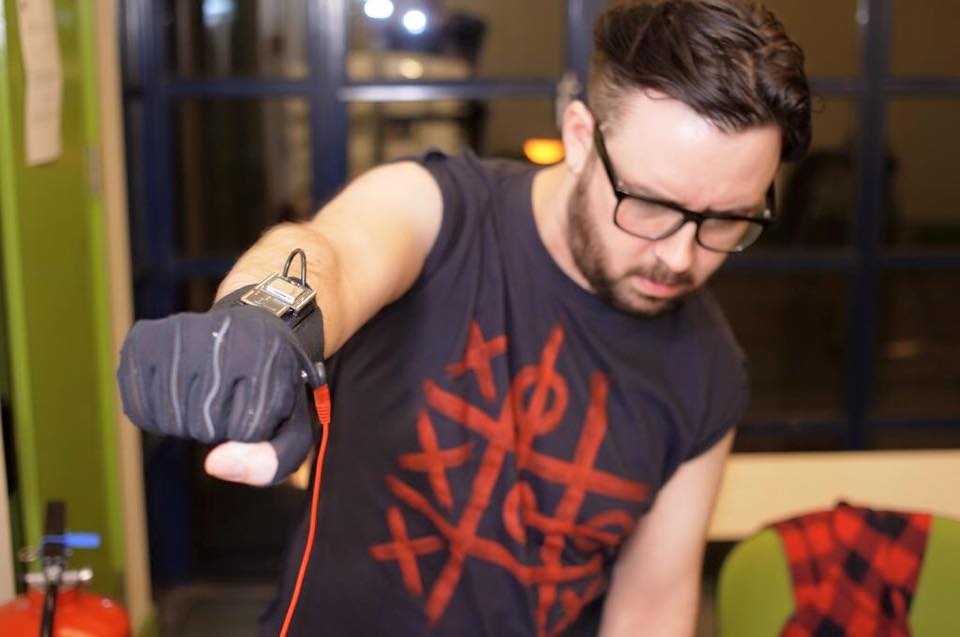
    The MiMu Gloves represent what I consider to be the clearest musical example of the Social Model of Disability. I face barriers to traditional instruments because of my hand impairment. I can’t change the shape of a piano to allow my right hand to play a chord. But the barrier isn’t in me; it’s in the instrument, argues the Social Model. But with a glove, I can put the chord wherever I want, with any hand posture I can access. The glove – by the very nature of its design – removes the physical barrier to expression for me. The Gloves aren’t accessible to everyone of course – not everyone has hands – but the concept of how I use them is a kind of Social Model Musicality.

    We can think about these two extremes – Medical vs Social – when we create any musical opportunity, either for ourselves as Disabled musicians, or for others as inclusive practitioners. What barriers are in the way of a person’s musical expression? I have to admit, while I’m skilled at solving these problems for others, I’m still learning how to apply this concept to my own musicianship. Maybe I always will be.

    When I say I’m Disabled, that is what I mean. I face barriers that society owns. That historical musical pedagogy upholds. I don’t “have” a Disability. It’s not something you can have, I would argue. being Disabled is something you face, something that is put upon you by external forces.

    The Social Model has been much more widely adopted in recent years, and I see it used to leverage meaningful action across the creative sector. I’ve been able to support embedding its usage across the arts sector, especially in music; and I’m grateful that so much has changed. I’d argue it creates a meaningful place to fully understand Disabled experience from, and something that can contribute to a richer and more human society.

  • On Late Diagnosis ADHD.

    On Late Diagnosis ADHD.

    I’ll get straight to it. So, turns out… I have ADHD.

    I was not a hyperactive kid, so this came as a bit of a surprise. That says more about my misconceptions around ADHD than anything else.

    At least, I wasn’t an externally hyperactive kid. And there’s a pretty good reason for that of course; I could barely walk, FFS. You weren’t likely to be running around and climbing trees, Halpin. Inside though, man; I was absolutely FIZZING.

    And of course, ADHD isn’t exclusively about hyperactivity. Ah, the rabbit holes of miseducation and internalised ableism. For kids in the 90s, ADHD was presented as “that thing naughty boys have” – a grotesque ableist simplification. A gender politics dumpster fire too; girls wouldn’t even be recognised as being able to have ADHD until the Early Noughties.

    They ask you to think back to school a lot in an ADHD assessment. I’ve slowly unravelled a sort of parallel universe childhood; one that includes an answer as to why I hated school, even though I tried to people-please the shit out of it. I was just so f’cking overwhelmed. And bored. Ugh. It felt like prison at the time. At least I can understand why it was so unbearably difficult.

    The hardest part to process is having a why for how chaotic my work is. That why quickly gives way to a what if. What if I’d known this years ago? I have so much unfinished music. So many half explored rabbit holes. I start projects, I abandon them when the initial excitement wears off. It’s really horrible, and I’ve lived with low-key self-loathing and regret for most of my adult life.

    Why can’t I just get stuff done?

    Well, at least there’s an answer now. It’s a clear answer. It’s a provable, measurable thing.

    I was diagnosed with “severe” combined ADHD. Combined ADHD balances on a scale between Hyperactive and Inattentive ADHD types; unsurprisingly, my diagnosis is weighted towards the Inattentive end of the scale.

    I’m still processing how this raises as many questions as it answers, but it’s a very good thing; of course it is. A context from which to be more compassionate to myself hopefully.

    One More Thing.

    I live in Warwickshire. Here, the pathways for ND diagnosis were closed to all adults a couple of years ago. So, yes; I went private. Yep, it’s expensive. £750 for the curious. We also can’t access what’s called Shared Care here, so if I were to access medication, that’s also a private healthcare cost. Can’t really think about that right now; having Cerebral Palsy is expensive enough.

    But, yes; for the avoidance of doubt – this is still a win. It’s late in the day, but better late than never. It’s a lot of feelings, but I trust my processes; I’ll be better off for knowing than not knowing. of course’m ready to do the work, figure this thing out. I hope my best work is still ahead of me.

    Shoutout to my fellow Late Diagnosis crew; there’s a fair few of us about now… more on that next time x

  • Some Of You Have Giant Teddy Bears.

    Some Of You Have Giant Teddy Bears.

    The carny allocated a giant teddy bear to that poor sucker the way that platforms allocate surpluses to key performers—as a convincer in a “Big Store” con, a way to rope in other suckers who’ll make content for the platform, anchoring themselves and their audiences to it.

    If you are a creative person on social media – especially if you are one of my fellow musicians hoping to “crack” the algo – I really think you should read this blog post by Cory Doctorow on the Enshittification of platforms.

    I know so many artists who live in agonising hope of social media success. There are no gatekeepers any more! Anyone can succeed! You just have to crack the codes of the algorithm. Find its rhythms. Please it, and all will be yours.

    There’s no code. There’s nothing to solve. This is just another gatekeeper.

    It doesn’t deserve the emotional tax you pay it.

    Advertisers are the customers. Attention is the product. You know this already. But we have to stop indulging this cruel game that we can succeed – make it! – on social media if we can just figure out the algorithm. There’s no patterns. No strategy. Some people have to win, or the whole thing falls flat.

    There’s a woman in my local community who wears a hat on TikTok. That’s the concept. She has more followers than I’ll ever have. I’m not having a go. Good for her. It clearly brings joy. But this can’t be mistaken for a strategy. She isn’t better at this than you or I. She was allowed to win the big bear, so we can see her walking round the fair with the big bear.

    That’s why we think we can win a bear too.

    Someone needs to win the bear.

    Focuses on TikTok, but the rules apply across the board. The claw machine has worked for some people. It has to. It has promised you fame and fortune. It has to pay out sometimes.

    TikTok has tried to give me a giant teddy bear. I was very excited to get it. 25k views on one pretty random video. If I keep playing, I’ll get to keep the bear.

    We deserve better than this.

    I used Jeepy-T to create the featured image on a blogpost about the enshittification of the internet. Oh, funnysad irony.

    xKH

  • Doctor’s Orders: Re-Released for 2025

    Doctor’s Orders: Re-Released for 2025

    Here’s another curiosity from the archives. I was still getting to grips with my new studio, and figuring out how to make software sounds sound lesss softwarey, for want of a better word

    It’s just a little piano work, a foreshadowing of my return to more serious instrumental composition. It has a spooky charm, as do most things of this time. I think I imagined it like an opening suite, probably taking cues from Tubular Bells, as I often do.

    Streaming wherever you get your music x

  • Ghostships – Rereleased for 2025

    Ghostships – Rereleased for 2025

    I’ve been making for so long, that a whole bunch of my career happened pre-streaming. When I recorded my first solo single, there were just a few places you could share music online – remember Overplay, anyone? Most of this music got lost as I moved into the modern chapter of my career, with the gloves and all the adventures that brings.

    That inevitably means that a lot of people who know my music now, don’t know where it began. I’ve been thinking about this a lot lately, but thankfully my original Mac, collecting dust in my studio, still works and contains a huge archive of songs and recordings.

    There’s definitely a right time to revisit old work. You can’t force it. I went through a long period of being quite dismissive of my past, only looking forward. I’ve been through a lot personally over the last year, and it’s been a time of taking stock and reflecting. In that, it now feels like a good time to introduce – re-introduce – a younger version of myself to my modern audience.

    Ghostships was my first single as a solo artist. It’s a dark downward spiral meditation on the bleakest ends to relationships. The death of a relationship. a Ghostship.

    It’s from another life, with a meaning that is long gone to me, but songs take on new meanings. This song – I’m told – still means a lot to a few people who remember it. It deserves a new life, a new audience to find their own meanings in it.

    It’s a very lo-fi recording, but it has a charm. I’ve got the stems, I may remix it, but for now, this is the original release, made little louder and tighter for streaming.

    There’s lots more on the way, I hope you enjoy this little curiosity from my past life x

    Streaming now, wherever you get your music.